
Online personal training runs on the same principle as any coaching relationship: someone is paying attention to what you do between sessions. The difference is that nobody is standing next to you at the rack, watching the clock, or asking how the week went while you catch your breath. Accountability has to be built into the program itself rather than supplied by proximity.
That suits anyone whose schedule will not hold a standing gym appointment. A remote program can hold you to a standard firmly enough, provided the check-ins, tracking, and consequences are defined before you start. Here is how to make that happen.
Why Accountability Feels Different Without a Live Trainer
In person, part of the accountability is physical. An appointment exists, a person is expecting you, and the session happens whether or not you feel motivated that morning. Personal training accountability is defined as the ongoing support a trainer provides to help a client stay committed to workouts, goals, and healthy habits, and that support does not vanish when the trainer is remote. What disappears is the automatic cue of someone waiting in the room.
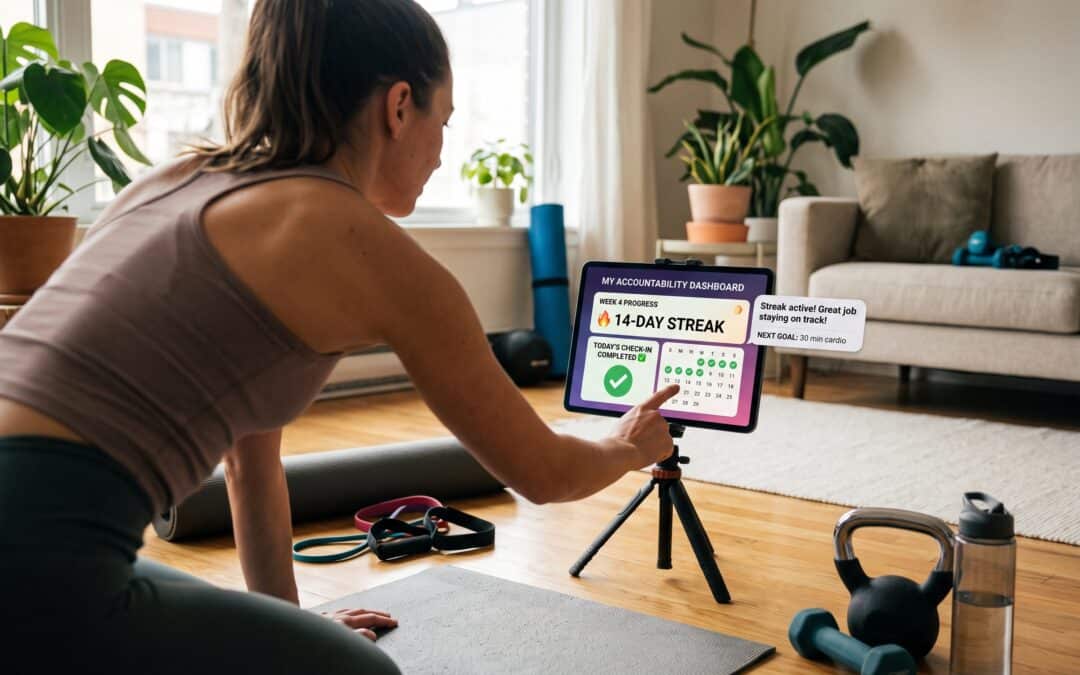
Remote clients replace that cue with something deliberate: a log, a weekly call, a message thread, or a shared dashboard. Each of those works only if both people agree on what gets shared and how often.
Build Accountability Into the Program, Not Around It
Dedicated accountability coaching from an online trainer is intended to keep a client on course for fitness goals, and the strongest programs treat it as part of the service rather than an add-on. When you review a program, look for the accountability mechanics first: how progress is reported, who reviews it, how often feedback arrives, and what changes when the plan is not working.
A program that consists of a workout file and a login is a library, not coaching. A program with a recurring check-in, a place to log sessions, and a stated response expectation is a relationship. The second version is what keeps people training in month four.
Use Scheduled Check-Ins as Your Anchor
Pick one fixed point in the week and treat it as non-negotiable. Some online coaching models are built around daily accountability, where a client logs each day and the trainer makes contact if a log is missed, in one published example within 24 hours. You do not need that frequency to succeed, but you do need to know exactly what your trainer expects and when.
Ask directly: what do you want logged, by when, and what happens if I go quiet? A coach who answers with specifics is running a system. A coach who answers vaguely is hoping you stay motivated on your own.

Track the Whole Day, Not Just the Workout
Accountability coaching increasingly looks past the training session. One published description frames an accountability coach as managing performance across all 24 hours of the day, monitoring sleep quality, nutrition adherence, and biometrics alongside training. The principle holds even without gadgets: the workout is roughly an hour, and the other twenty-three decide how much it counts.
Keep the tracking simple enough that you will actually do it. Sleep hours, meals that followed the plan, steps, and whether the session happened cover most of what matters.
Decide in Advance What Happens When You Miss
Missing a session is normal. Missing one and then disappearing for two weeks is the pattern that ends programs, and it usually starts with a vague feeling of having fallen behind. Remove the drama by setting the rule before you need it.
- Report the missed session in the same log, with a one-line reason.
- Your trainer reschedules it or drops it, whichever was already agreed.
- No apology essay, and no restarting the plan from week one.
A missed log that triggers a check-in within a set window is useful precisely because it removes the decision about whether to confess. The system asks, and you answer.
Turn Goals Into Weekly Commitments
Improving fitness accountability is largely about building the habits that keep you on course, and habits respond better to small weekly commitments than to large seasonal goals. A target like getting stronger over six months is too far away to influence a Tuesday morning. A commitment like three sessions and two walks before Sunday is close enough to act on.
Write the commitments where your trainer can see them and let them hold you to the number. When the week goes well, the check-in is short. When it does not, the conversation becomes about which commitment was unrealistic rather than whether you have discipline.

Choose a Coach Who Treats Accountability as Part of the Service
The quality of online personal training accountability depends far more on the coach’s system than on the platform. Before committing, ask the questions that reveal how the relationship will actually run.
Questions to ask before you commit
- How often do we check in, and in what format?
- What exactly do you want me to log, and by when?
- What happens if I miss a log or a session?
- How quickly should I expect a reply, and through which channel?
- How do you adjust the plan when progress stalls or life changes?
- Who reviews my progress, and is it always you?
Response windows and check-in frequency vary by provider, so confirm them in writing rather than assuming a default.
Set Up Your Environment and Schedule
Remote training removes the commute, which also removes the built-in appointment. Create the appointment yourself with a calendar entry, a training space you do not have to clear each time, and equipment you can reach in under a minute. Friction threatens home programs more than motivation does.
Schedule training at times you can defend. Early mornings and late evenings work for many people because little else competes for that slot, but the right answer is whichever window you can keep several weeks in a row.

Add Outside Support Without Giving Away the Plan
An accountability partner can help with wellness and nutrition goals, and plenty of people look for exactly that kind of mutual support. Pairing a friend with your program works as long as the roles stay clear: the partner checks that you showed up, and the trainer decides what you should do.
Group coaching is another option some trainers offer alongside one-to-one work. A group adds visibility, since other members notice when you are absent, without taking programming decisions away from your coach.
Working With a Rhode Island Coach Online
Marimar Prolific Performance, the practice of Mary, is based in Rhode Island and offers private personal training in person, as concierge coaching, and online, along with wellness coaching for habit building. Clients in Newport, Pawtucket, and the greater Providence area can combine remote programming with periodic in-person sessions, while clients outside the state can work entirely online.
Whichever format you choose, the same rule applies: the accountability has to be specified up front. Ask what the check-in rhythm looks like, how progress is reported, and what happens on the weeks when training is the last thing you want to do.
Frequently Asked Questions
What is personal training accountability?
It is the ongoing support a trainer provides to help a client stay committed to workouts, goals, and healthy habits. In practice that means check-ins, progress reviews, and adjustments when the plan is not working. Online, the same support arrives through messages, logs, calls, or shared tracking rather than through a trainer standing beside you during the session.
How often should an online trainer check in?
There is no single standard. Some online programs are built on daily logging, while others run on a weekly review with messages in between. Frequency matters less than clarity. Confirm the schedule in writing before you start, and make sure it is a rhythm you can realistically keep for months rather than weeks.
What happens if I miss a workout or a log?
That depends on the coach, so ask before you commit. Some programs are designed so that a missed log triggers contact from the trainer within a set window, in one published example within 24 hours. Others simply review missed sessions at the weekly check-in. Either can work, but you should know which one you signed up for.
Can I stay accountable without a trainer at all?
Partly. An accountability partner or a training group can keep you showing up, and tracking habits on your own helps too. What outside support tends not to provide is programming: deciding what to do, adjusting load, and knowing when to change the plan. Many people combine the two, using a partner for presence and a coach for direction.